2025 - Morcelliana
ID: 6171520
Article PDF (0.59 Mb)
Compatible only with Adobe Acrobat Reader - free software - (find out how to open the files)
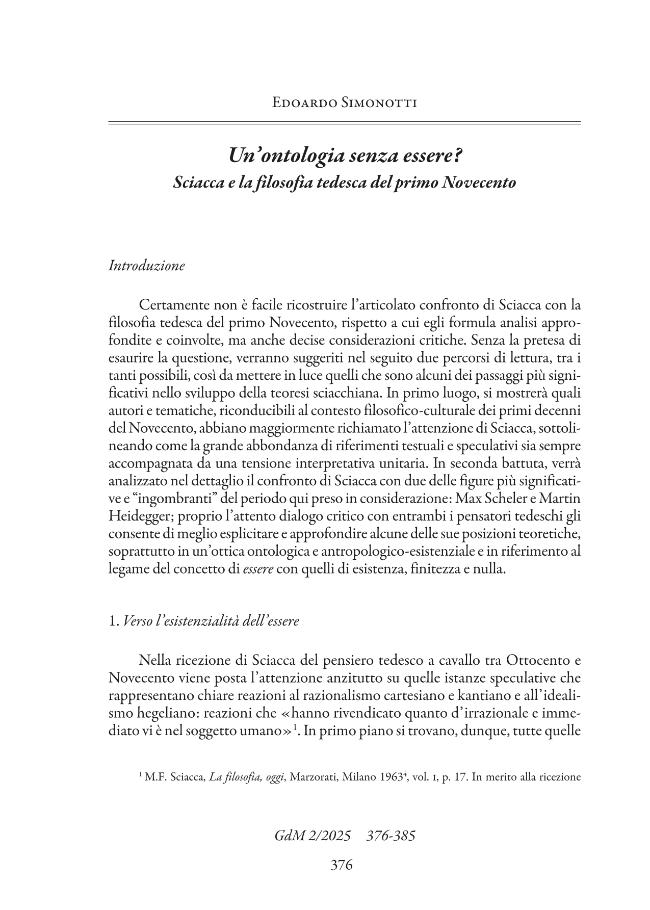
Un'ontologia senza essere? : Sciacca e la filosofia tedesca del primo Novecento
P. 376-385
This paper analyses Sciacca's complex confrontation with early twentieth-century German philosophy, highlighting two possible reading avenues. First, it describes the anti-rationalist and anti-idealist context of vitalism and historicism, to which Sciacca has consistently directed his attention. Secondly, it analyses Sciacca's engagement with two of the most significant figures of the period considered here: Max Scheler and Martin Heidegger. It is precisely the careful critical dialogue with the two German thinkers that allows Sciacca to explain and further develop some of his theoretical positions, especially from an ontological and anthropological-existential perspective, and with reference to the connection between the concept of being and those of existence, finitude, and nothingness.
Particular attention is paidt o Sciacca's definition of Heideggerian existentialism in the paradoxical and contradictory terms of an "ontology without being" [Publisher's Text].
23328 characters
Is part of
Giornale di metafisica : XLVII, 2, 2025-
Articles from the same issue (available individually)
-
Information
ISSN: 0017-0372
DISCIPLINES
KEYWORDS
- Sciacca, Heidegger, Ontology, Existentialism, Nihilism
VAT Excluded
PDF
Article
Article
View the Terms of Use