2026 - Franco Angeli

ID: 6226860
Artículo PDF (0,3 Mb)
Compatible solo con Adobe Acrobat Reader - software gratuito - (descubra cómo abrir los archivos)
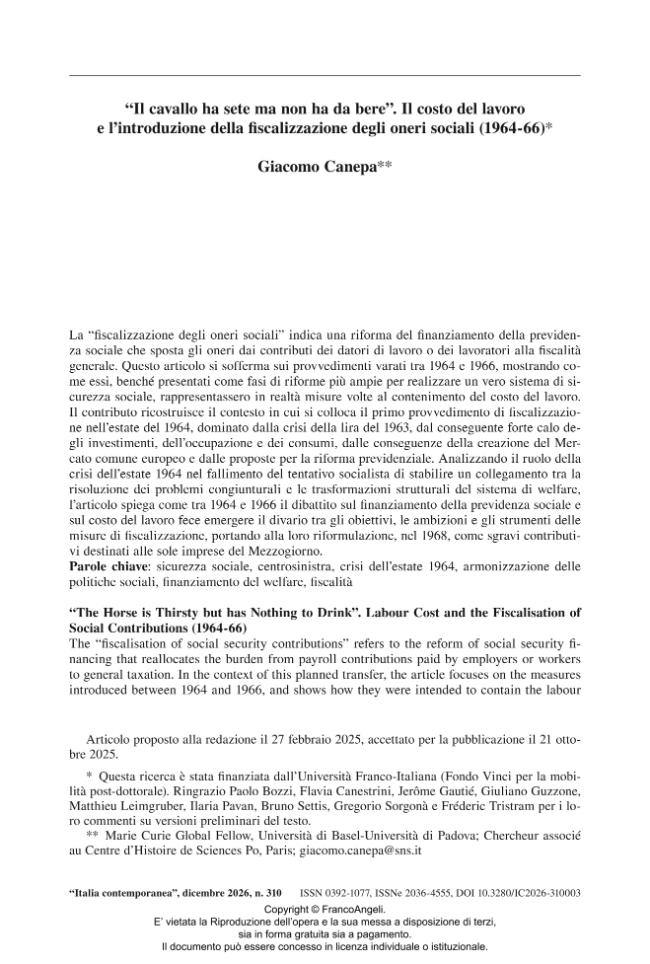
"Il cavallo ha sete ma non ha da bere" : il costo del lavoro e l'introduzione della fiscalizzazione degli oneri sociali (1964-66)
36-66 p.
La "fiscalizzazione degli oneri sociali" indica una riforma del finanziamento della previdenza sociale che sposta gli oneri dai contributi dei datori di lavoro o dei lavoratori alla fiscalità generale. Questo articolo si sofferma sui provvedimenti varati tra 1964 e 1966, mostrando come essi, benché presentati come fasi di riforme più ampie per realizzare un vero sistema di sicurezza sociale, rappresentassero in realtà misure volte al contenimento del costo del lavoro. Il contributo ricostruisce il contesto in cui si colloca il primo provvedimento di fiscalizzazione nell'estate del 1964, dominato dalla crisi della lira del 1963, dal conseguente forte calo degli investimenti, dell'occupazione e dei consumi, dalle conseguenze della creazione del Mercato comune europeo e dalle proposte per la riforma previdenziale. Analizzando il ruolo della crisi dell'estate 1964 nel fallimento del tentativo socialista di stabilire un collegamento tra la risoluzione dei problemi congiunturali e le trasformazioni strutturali del
sistema di welfare, l'articolo spiega come tra 1964 e 1966 il dibattito sul finanziamento della previdenza sociale e sul costo del lavoro fece emergere il divario tra gli obiettivi, le ambizioni e gli strumenti delle misure di fiscalizzazione, portando alla loro riformulazione, nel 1968, come sgravi contributivi destinati alle sole imprese del Mezzogiorno. [Testo dell'editore]
The "fiscalisation of social security contributions" refers to the reform of social security financing that reallocates the burden from payroll contributions paid by employers or workers to general taxation. In the context of this planned transfer, the article focuses on the measures introduced between 1964 and 1966, and shows how they were intended to contain the labour cost rather than serving as a first step towards a comprehensive reform of the social security system. Firstly, the article reconstructs the context in which the first fiscalisation measure was introduced in the summer of 1964. Such context was marked by the 1963 crisis of the lira, followed by a sharp drop in investment, employment and consumption, as well as by the consequences of the creation of the European Common Market. Secondly, it positions the 1964 crisis within the unsuccessful socialist attempt to establish a link between the resolution of cyclical problems and the structural transformation of the social security system. In doing
so, the article shows how the 1964-66 debate on welfare funding and labour cost highlighted the gap between objectives, ambitions, and tools of the fiscalisation measures, eventually leading to their reformulation in 1968 as tax relief for companies in Southern Italy only. [Publisher's text]
Forma parte de
Italia contemporanea : 310, 1, 2026-
Artículos del mismo número (disponibles individualmente)
-
Información
Código DOI: 10.3280/IC2026-310003
ISSN: 2036-4555
KEYWORDS
- sicurezza sociale, centrosinistra, crisi dell'estate 1964, armonizzazione delle politiche sociali, finanziamento del welfare, fiscalità
- social security, centre-left coalition, political crisis of summer 1964, harmonisation of social policies, financing of the welfare state, taxation
IVA excluido
PDF
Artículo
Artículo
Consulta las condiciones de uso