2024 - Leo S. Olschki
ID: 6134207
Artikel PDF (0,36 Mb)
Nur mit Adobe Acrobat Reader kompatibel - kostenlose Software - (erfahren Sie, wie Sie die Dokumente öffnen)
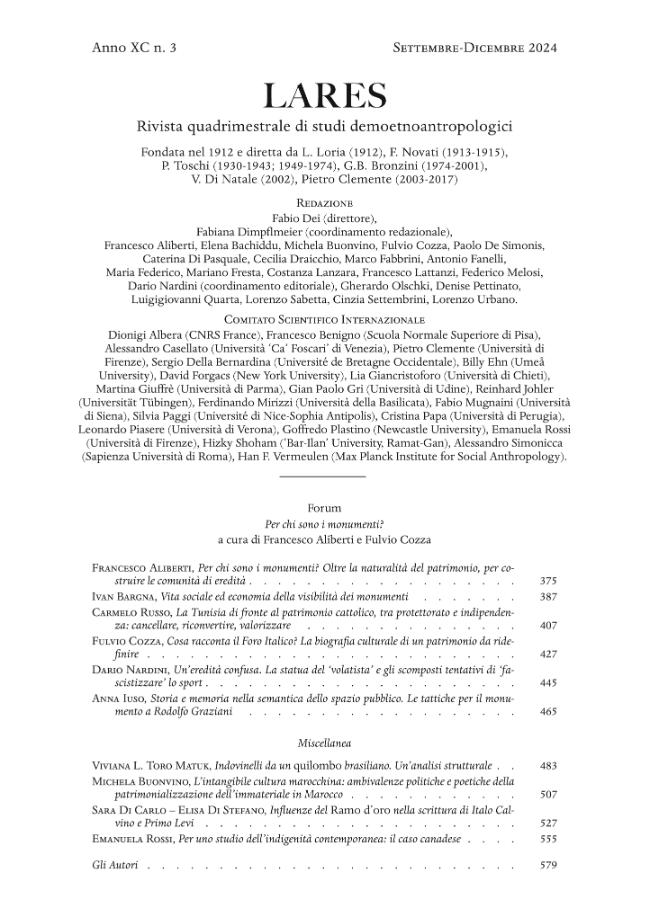
Vita sociale ed economia della visibilità dei monumenti
P. 387-406
Quella che oggi si vive in occidente, ma anche altrove, sembra essere da un lato l'era della fine dei monumenti e nel contempo quella di un ampliamento ipertrofico dello spazio monumentale mosso sia dalla fascinazione estetizzante per l'antico e per l'esotico che anima il turismo culturale globale sia dalla valorizzazione della via ordinaria resa possibile dalla disseminazione della nozione antropologica della cultura. In questo cotesto, che cosa si debba intendere per monumento appare sempre più problematico e incerto, nella misura in cui se tutto può diventare monumento, allora niente lo è più. Una situazione che proprio per la sua incertezza apre alla possibilità di una decostruzione del ‘monumento' come nozione e artefatto, indebolendone l'eurocentrismo per allargare ad altre pratiche culturali di iscrizione del tempo nello spazio, dell'invisibile nel visibile, del passato nel presente.
Intrecciando riflessione teorica ed esperienza etnografica, con particolare riferimento alle ricerche condotte dall'autore fra 2002 a 2015 nel regno camerunese di Bandjoun, l'articolo indaga la vita sociale e l'economia della visibilità dei ‘monumenti' intesi come cronotipi che articolano i rapporti fra vita e morte, deperibile e durevole, memoria e oblio, cose e persone, umano e oltreumano. Dispositivi di potere-sapere che nel momento stesso in cui affermano un certo ordinamento del mondo ricordano alle comunità i nodi irrisolti e incistati della loro vita relazionale: conflitti irrisolti, debiti non riconosciuti, ferite non sanate. A partire da queste considerazioni, il fatto che i monumenti possano essere attaccati e distrutti non va visto allora come un accidente ma come parte costitutiva della loro biografia e vita sociale, della fragilità che si lega la loro materialità, dell'essere arma e posta in gioco di conflitti che li vedono nascere e morire. [Testo dell'editore]
What we are experiencing today in the West, but also elsewhere, seems to be, on the one hand, the era of the end of monuments and, at the same time, that of a hypertrophic expansion of monumental space driven both by the aesthetic fascination for the ancient and the exotic that animates global cultural tourism and by the valorisation of ordinary life made possible by the dissemination of the anthropological notion of culture. In this context, what is meant by monument appears increasingly problematic and uncertain, insofar as if everything can become a monument, then nothing is one anymore. Precisely because of its uncertainty, this situation opens up the possibility of deconstructing the ‘monument' as a notion and artefact, weakening its Eurocentrism in order to extend it to other cultural practices of inscribing time in space,the invisible in the visible, the past in the present. Intertwining theoretical reflection and ethnographic experience,
with particular reference to the author's research conducted between 2002 and 2015 in the Cameroonian kingdom of Bandjoun, the article investigates the social life and economy of the visibility of “monuments” understood as chronotypes that articulate the relationships between life and death, the perishable and the durable, memory and oblivion, things and people, the human and the beyond-human. These are devices of power-knowledge which, at the very moment they affirm a certain order of the world, remind communities of the unresolved and encrusted knots of their relational life: unresolved conflicts, unacknowledged debts, unhealed wounds. Starting from these considerations, the fact that monuments can be attacked and destroyed should not be seen as an accident but as a constitutive part of their biography and social life, of the fragility linked to their materiality, of their being weapons and stakes in the conflicts that see them born and die. [Publisher's text]
66741 characters
-
Artikel aus derselben Ausgabe (einzeln erhältlich)
-
Informationen
DOI: 10.82026/12009
ISSN: 2036-511X
THEMENBEREICHE
MwSt ausgenomen
PDF
Artikel
Artikel
Erlaubte Funktionen anzeigen