2025 - Franco Angeli

ID: 6183214
Articolo PDF (0,7 Mb)
Consultabile solo con Adobe Acrobat Reader - software gratuito - (scopri come aprire i documenti)
Being Yugoslavian today : unity and separateness in the emotional legacy of Yugoslavia through Jungian lenses
2025 - Franco Angeli
38-51 p.
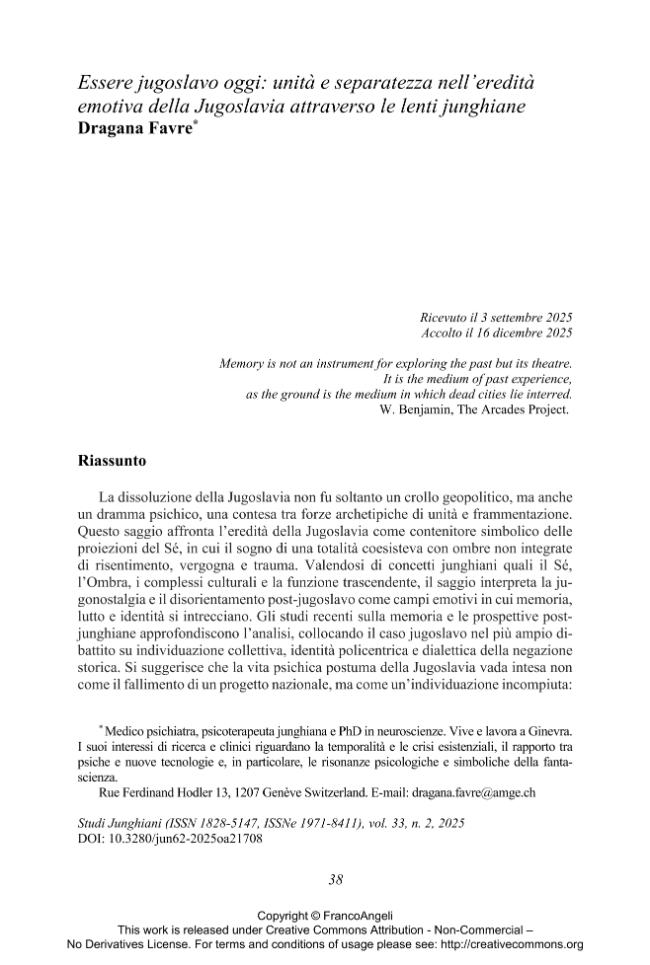
The dissolution of Yugoslavia was not only a geopolitical collapse but also a psychic drama, a struggle between archetypal forces of unity and fragmentation. This paper approaches the legacy of Yugoslavia as a symbolic container for projections of the Self, where the dream of wholeness coexisted with unintegrated shadows of grievance, shame, and trauma. Using Jungian concepts such as the Self, shadow, cultural complexes, and the transcendent function, this paper interprets Yugonostalgia and post-Yugoslav disorientation as emotional fields where memory, mourning, and identity intertwine. Recent memory studies and post-Jungian perspectives deepen this analysis, situating the Yugoslav case within broader debates on collective individuation, polycentric identity, and the dialectics of historical negation. The argument suggests that Yugoslavia's psychic afterlife is best understood not as the failure of a national project but as an unfinished individuation: a demand to hold multiplicity without regression, to
transform nostalgia into symbolic creativity. The Yugoslav legacy thus illuminates a wider human challenge-how to imagine wholeness without erasing difference, and how to live with plurality without collapse. [Publisher's Text]
-
Articoli dello stesso fascicolo (disponibili singolarmente)
-
Informazioni
Codice DOI: 10.3280/jun62-2025oa21708
ISSN: 1971-8411
MATERIE
PAROLE CHIAVE
- Jugoslavia, eredità emotiva, teoria junghiana, unità e separatezza, jugonostalgia, complessi culturali, memoria collettiva, individuazione
- Yugoslavia, emotional legacy, Jungian theory, unity and separation, Yugonostalgia, cultural complexes, collective memory, individuation