2025 - Franco Angeli
ID: 6183206
Articolo PDF (0,09 Mb)
Consultabile solo con Adobe Acrobat Reader - software gratuito - (scopri come aprire i documenti)
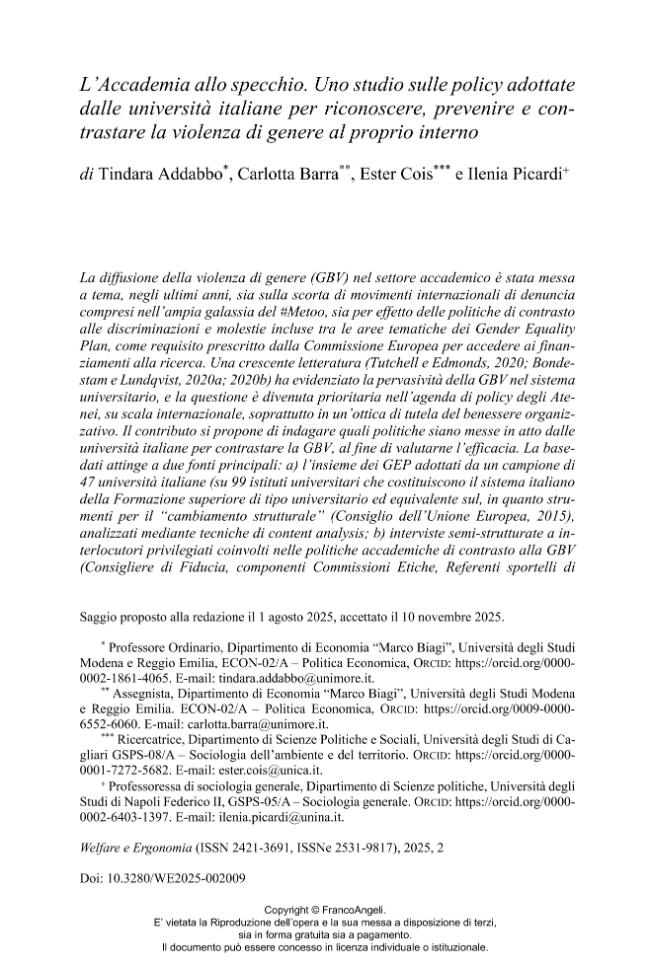
L'Accademia allo specchio : uno studio sulle policy adottate dalle università italiane per riconoscere, prevenire e contrastare la violenza di genere al proprio interno
121-138 p.
La diffusione della violenza di genere (GBV) nel settore accademico è stata messa a tema, negli ultimi anni, sia sulla scorta di movimenti internazionali di denuncia compresi nell'ampia galassia del #Metoo, sia per effetto delle politiche di contrasto alle discriminazioni e molestie incluse tra le aree tematiche dei Gender Equality Plan, come requisito prescritto dalla Commissione Europea per accedere ai finanziamenti alla ricerca. Una crescente letteratura (Tutchell e Edmonds, 2020; Bondestam e Lundqvist, 2020a; 2020b) ha evidenziato la pervasività della GBV nel sistema universitario, e la questione è divenuta prioritaria nell'agenda di policy degli Atenei, su scala internazionale, soprattutto in un'ottica di tutela del benessere organizzativo. Il contributo si propone di indagare quali politiche siano messe in atto dalle università italiane per contrastare la GBV, al fine di valutarne l'efficacia. La base-dati attinge a due fonti principali: a) l'insieme dei GEP adottati da un campione di 47 università
italiane (su 99 istituti universitari che costituiscono il sistema italiano della Formazione superiore di tipo universitario ed equivalente sul, in quanto strumenti per il "cambiamento strutturale" (Consiglio dell'Unione Europea, 2015), analizzati mediante tecniche di content analysis; b) interviste semi-strutturate a interlocutori privilegiati coinvolti nelle politiche accademiche di contrasto alla GBV (Consigliere di Fiducia, componenti Commissioni Etiche, Referenti sportelli di ascolto e anti-violenza, membri Comitati Unici di Garanzia, rappresentanti componente studentesca, delegati/e del Rettore per le pari opportunità, etc.). [Testo dell'editore]
The incidence of gender-based violence (GBV) in the academic sector has increasingly come under scrutiny in recent years, both as a result of international denunciation movements within the broad constellation of #MeToo, and due to anti-discrimination and anti-harassment policies included among the thematic areas of Gender Equality Plans (GEPs), now required by the European Commission for access to research funding. A growing body of literature (Tutchell and Edmonds, 2020; Bondestam and Lundqvist, 2020a; 2020b) has highlighted the pervasiveness of GBV in the university system, and the issue has become a policy priority for higher education institutions globally, particularly in terms of ensuring organisational well-being. This paper aims to investigate the policies implemented by Italian universities to combat GBV, with the goal of assessing their effectiveness. The dataset draws on two primary sources: a) the full set of GEPs adopted by a sample of 47 Italian universities (out of the 99 institutions that
make up the Italian higher education system, including universities and equivalent institutions), analysed through content analysis techniques, in light of their role as tools for "structural change" (Council of the European Union, 2015); b) semi-structured interviews with key stakeholders involved in academic GBV prevention and response policies (such as Confidential Advisors, members of Ethics Committees, representatives of listening and anti-violence centres, members of Equal Opportunities Committees, student representatives, and the Rector's delegates for gender equality, among others). [Publisher's Text]
Fa parte di
Welfare e ergonomia : XI, 2, 2025-
Articoli dello stesso fascicolo (disponibili singolarmente)
-
Informazioni
Codice DOI: 10.3280/WE2025-002009
ISSN: 2531-9817
PAROLE CHIAVE
- Violenza di Genere, Università, Welfare, Gender Equality Plan, Benessere Organizzativo
- Gender-based Violence, Universities, Welfare, Gender Equality Plan, Organizational Wellbeing
Iva esclusa
PDF
Articolo
Articolo
Leggi le condizioni d'uso