2025 - Franco Angeli
ID: 6134850
Articolo PDF (0,3 Mb)
Consultabile solo con Adobe Acrobat Reader - software gratuito - (scopri come aprire i documenti)
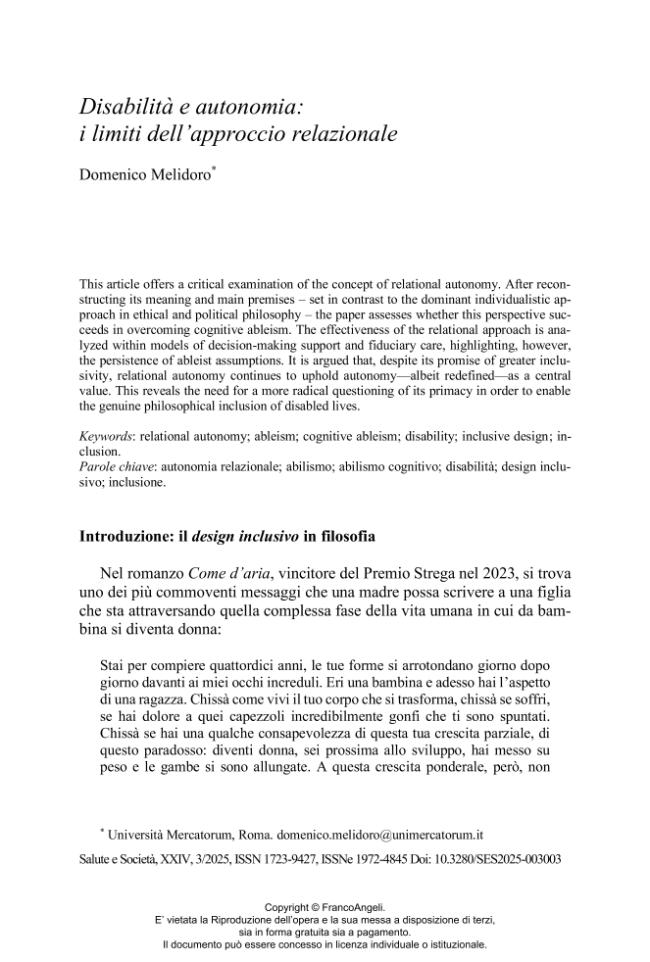
Disabilità e autonomia : i limiti dell'approccio relazionale
35-48 p.
This article offers a critical examination of the concept of relational autonomy. After reconstructing its meaning and main premises set in contrast to the dominant individualistic approach in ethical and political philosophy the paper assesses whether this perspective succeeds in overcoming cognitive ableism. The effectiveness of the relational approach is analyzed within models of decisionmaking support and fiduciary care, highlighting, however, the persistence of ableist assumptions. It is argued that, despite its promise of greater inclusivity, relational autonomy continues to uphold autonomy albeit redefined as a central value. This reveals the need for a more radical questioning of its primacy in order to enable the genuine philosophical inclusion of disabled lives. [Publisher's text]
Fa parte di
Salute e società : XXIV, 3, 2025-
Articoli dello stesso fascicolo (disponibili singolarmente)
-
Informazioni
Codice DOI: 10.3280/SES2025-003003
ISSN: 1972-4845
MATERIE
PAROLE CHIAVE
- autonomia relazionale, abilismo, abilismo cognitivo, disabilità, design inclusivo, inclusione
- relational autonomy, ableism, cognitive ableism, disability, inclusive design, inclusion
Iva esclusa
PDF
Articolo
Articolo
Leggi le condizioni d'uso