2025 - Franco Angeli
ID: 6134799
Articolo PDF (0,43 Mb)
Consultabile solo con Adobe Acrobat Reader - software gratuito - (scopri come aprire i documenti)
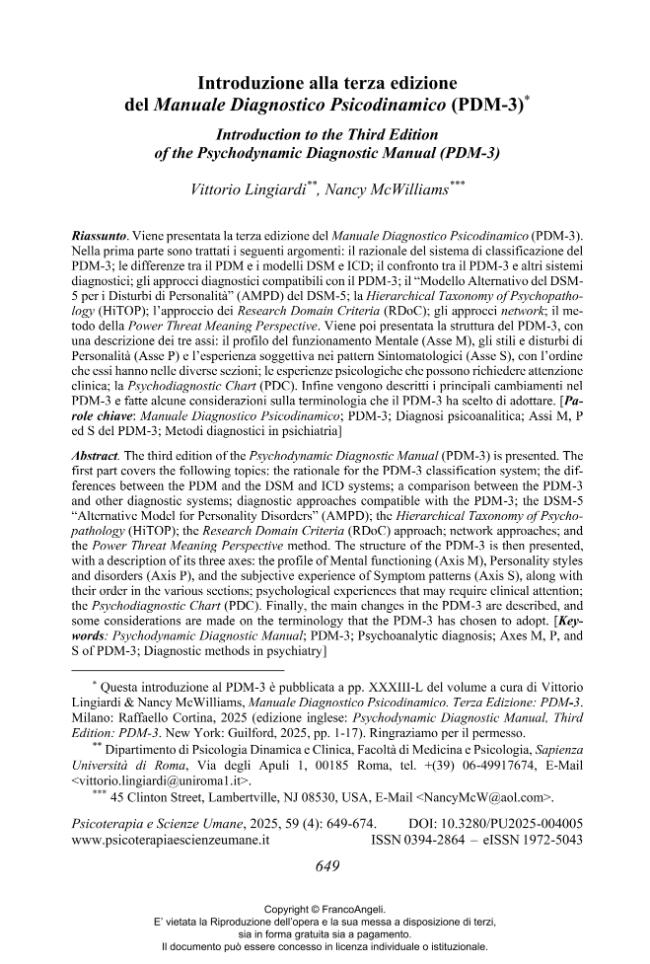
Introduzione alla terza edizione del Manuale Diagnostico Psicodinamico (PDM 3)
649-674 p.
Viene presentata la terza edizione del Manuale Diagnostico Psicodinamico (PDM3). Nella prima parte sono trattati i seguenti argomenti: il razionale del sistema di classificazione del PDM3; le differenze tra il PDM e i modelli DSM e ICD; il confronto tra il PDM3 e altri sistemi diagnostici; gli approcci diagnostici compatibili con il PDM3; il "Modello Alternativo del DSM5 per i Disturbi di Personalità" (AMPD) del DSM5; la Hierarchical Taxonomy of Psychopathology (HiTOP); l'approccio dei Research Domain Criteria (RDoC); gli approcci network; il metodo della Power Threat Meaning Perspective. Viene poi presentata la struttura del PDM3, con una descrizione dei tre assi: il profilo del funzionamento Mentale (Asse M), gli stili e disturbi di Personalità (Asse P) e l'esperienza soggettiva nei pattern Sintomatologici (Asse S), con l'ordine che essi hanno nelle diverse sezioni; le esperienze psicologiche che possono richiedere attenzione clinica; la Psychodiagnostic Chart (PDC). Infine vengono
descritti i principali cambiamenti nel PDM3 e fatte alcune considerazioni sulla terminologia che il PDM3 ha scelto di adottare. [Testo dell'editore]
The third edition of the Psychodynamic Diagnostic Manual (PDM3) is presented. The first part covers the following topics: the rationale for the PDM3 classification system; the differences between the PDM and the DSM and ICD systems; a comparison between the PDM3 and other diagnostic systems; diagnostic approaches compatible with the PDM3; the DSM5 "Alternative Model for Personality Disorders" (AMPD); the Hierarchical Taxonomy of Psychopathology (HiTOP); the Research Domain Criteria (RDoC) approach; network approaches; and the Power Threat Meaning Perspective method. The structure of the PDM3 is then presented, with a description of its three axes: the profile of Mental functioning (Axis M), Personality styles and disorders (Axis P), and the subjective experience of Symptom patterns (Axis S), along with their order in the various sections; psychological experiences that may require clinical attention; the Psychodiagnostic Chart (PDC). Finally, the main changes in the PDM3 are described,
and some considerations are made on the terminology that the PDM3 has chosen to adopt. [Publisher's text]
Fa parte di
Psicoterapia e scienze umane : LIX, 4, 2025-
Articoli dello stesso fascicolo (disponibili singolarmente)
-
Informazioni
Codice DOI: 10.3280/PU2025-004005
ISSN: 1972-5043
MATERIE
PAROLE CHIAVE
- Manuale Diagnostico Psicodinamico, PDM-3, Diagnosi psicoanalitica, Assi M, P ed S del PDM-3, Metodi diagnostici in psichiatria
- Psychodynamic Diagnostic Manual, PDM-3, Psychoanalytic diagnosis, Axes M, P, and S of PDM-3, Diagnostic methods in psychiatry
Iva esclusa
PDF
Articolo
Articolo
Leggi le condizioni d'uso