2026 - Franco Angeli
ID: 6219808
Article PDF (0,86 Mb)
Pris en charge uniquement par Adobe Acrobat Reader - logiciel gratuit - (découvrez comment ouvrir les documents)
Il cinema che cura : narrazioni filmiche e trasformazione del sé.
189-217 p.
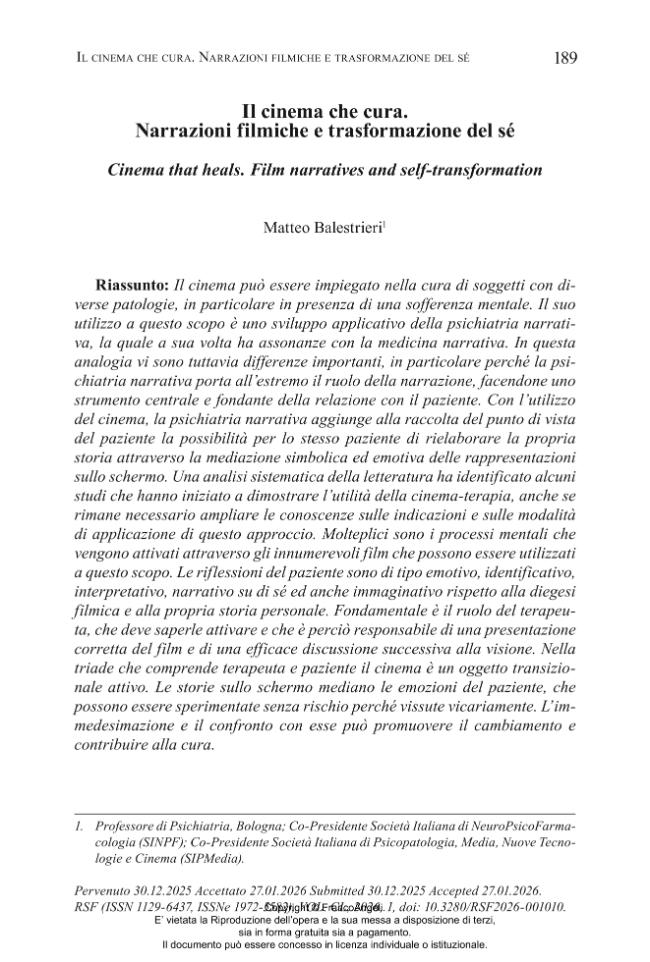
Il cinema può essere impiegato nella cura di soggetti con diverse patologie, in particolare in presenza di una sofferenza mentale. Il suo utilizzo a questo scopo è uno sviluppo applicativo della psichiatria narrativa, la quale a sua volta ha assonanze con la medicina narrativa. In questa analogia vi sono tuttavia differenze importanti, in particolare perché la psichiatria narrativa porta all'estremo il ruolo della narrazione, facendone uno strumento centrale e fondante della relazione con il paziente. Con l'utilizzo del cinema, la psichiatria narrativa aggiunge alla raccolta del punto di vista del paziente la possibilità per lo stesso paziente di rielaborare la propria storia attraverso la mediazione simbolica ed emotiva delle rappresentazioni sullo schermo. Una analisi sistematica della letteratura ha identificato alcuni studi che hanno iniziato a dimostrare l'utilità della cinematerapia, anche se rimane necessario ampliare le conoscenze sulle indicazioni e sulle modalità di applicazione di questo approccio
Molteplici sono i processi mentali che vengono attivati attraverso gli innumerevoli film che possono essere utilizzati a questo scopo. Le riflessioni del paziente sono di tipo emotivo, identificativo, interpretativo, narrativo su di sé ed anche immaginativo rispetto alla diegesi filmica e alla propria storia personale. Fondamentale è il ruolo del terapeuta, che deve saperle attivare e che è perciò responsabile di una presentazione corretta del film e di una efficace discussione successiva alla visione. Nella triade che comprende terapeuta e paziente il cinema è un oggetto transizionale attivo. Le storie sullo schermo mediano le emozioni del paziente, che possono essere sperimentate senza rischio perché vissute vicariamente. L'immedesimazione e il confronto con esse può promuovere il cambiamento e contribuire alla cura.[Testo dell'editore]
Cinema can be used in the treatment of individuals with various pathologies, particularly in cases of mental health conditions. Its use for this purpose is an application of narrative psychiatry, which in turn has similarities with narrative medicine. However, there are important differences in this analogy, particularly because narrative psychiatry takes the role of storytelling to the extreme, making it a central and fundamental tool in the relationship with the patient. Through the use of cinema, narrative psychiatry not only gathers the patient's point of view, but also offers them the opportunity to rework their own story through the symbolic and emotional mediation of on screen representations. A systematic analysis of the literature has identified a several studies that begin to demonstrate the usefulness of cinema therapy, although further work is needed to clarify the indications for, and methods of applying, this approach.There are many mental processes that are activated through the numerous films
that can be used for this purpose. Patients' reflections can be emotional, identificatory, interpretative, and self narrative, as well as imaginative in relation both to the film's diegesis and to their own personal history. The role of the therapist is fundamental, as they must be able to activate these processes and are therefore responsible for presenting the film appropriately and leading an effective post viewing discussion. In the triad comprising therapist and patient, cinema functions as an active transitional object. The stories on the screen mediate the patient's emotions, which can be experienced safely because they are lived vicariously. Identification with, and confronting, these emotions can foster change and contribute to the healing process. [Publisher's Text]
Fait partie de
Rivista sperimentale di freniatria : la rivista dei servizi di salute mentale : CL, 1, 2026-
Articles du même numéro (disponibles individuellement)
-
Informations
Code DOI : 10.3280/RSF2026-001010
ISSN: 1972-5582
DISCIPLINES
KEYWORDS
- Medicina Narrativa, Psichiatria Narrativa, Cinema, Narrazione, CinemaTerapia, Diegesi, Oggetto transizionale, Emozioni, Identificazioni, Interpretazioni, Immedesimazione, Mentalizzazione
- Narrative Medicine, Narrative Psychiatry, Cinema, Storytelling, Cinema Therapy, Diegesis, Transitional Object, Emotions, Identifications, Interpretations, Empathy, Mentalisation
TVA exclue
PDF
Article
Article
Voir les conditions d’utilisation