2026 - Franco Angeli
ID: 6219800
Article PDF (0,72 Mb)
Pris en charge uniquement par Adobe Acrobat Reader - logiciel gratuit - (découvrez comment ouvrir les documents)
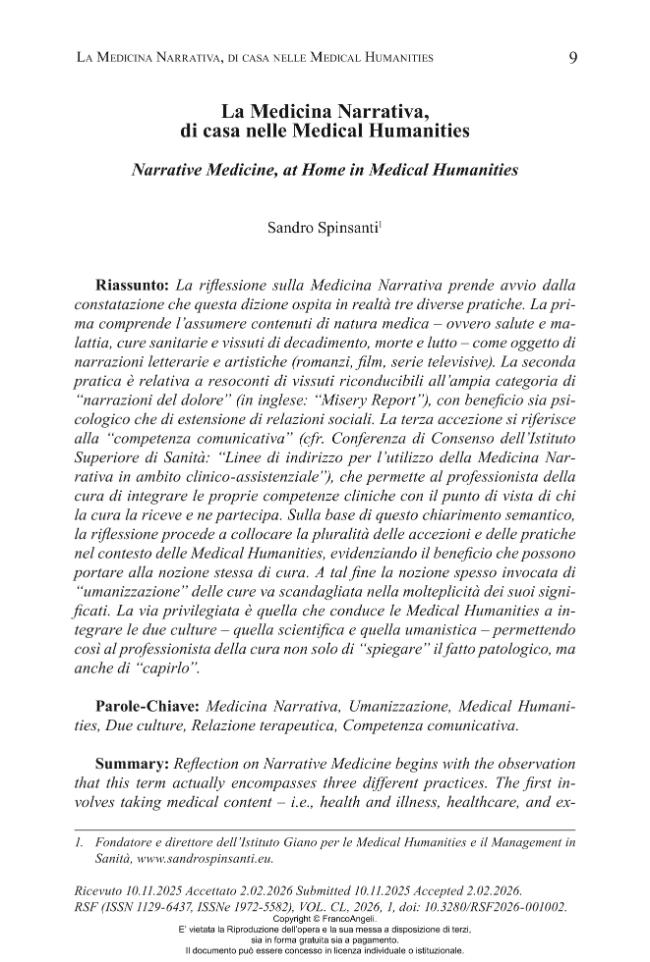
La Medicina Narrativa, di casa nelle Medical Humanities
9-23 p.
La riflessione sulla Medicina Narrativa prende avvio dalla constatazione che questa dizione ospita in realtà tre diverse pratiche. La prima comprende l'assumere contenuti di natura medica ovvero salute e malattia, cure sanitarie e vissuti di decadimento, morte e lutto come oggetto di narrazioni letterarie e artistiche (romanzi, film, serie televisive). La seconda pratica è relativa a resoconti di vissuti riconducibili all'ampia categoria di "narrazioni del dolore" (in inglese: "Misery Report"), con beneficio sia psicologico che di estensione di relazioni sociali. La terza accezione si riferisce alla "competenza comunicativa" (cfr. Conferenza di Consenso dell'Istituto Superiore di Sanità: "Linee di indirizzo per l'utilizzo della Medicina Narrativa in ambito clinico-assistenziale"), che permette al professionista della cura di integrare le proprie competenze cliniche con il punto di vista di chi la cura la riceve e ne partecipa. Sulla base di questo chiarimento semantico, la riflessione procede a collocare la
pluralità delle accezioni e delle pratiche nel contesto delle Medical Humanities, evidenziando il beneficio che possono portare alla nozione stessa di cura. A tal fine la nozione spesso invocata di "umanizzazione" delle cure va scandagliata nella molteplicità dei suoi significati. La via privilegiata è quella che conduce le Medical Humanities a integrare le due culture quella scientifica e quella umanistica permettendo così al professionista della cura non solo di "spiegare" il fatto patologico, ma anche di "capirlo".[Testo dell'editore]
Reflection on Narrative Medicine begins with the observation that this term actually encompasses three different practices. The first in-volves taking medical content i.e., health and illness, healthcare, and experiences of decline, death, and mourning as the subject of literary and artistic narratives (novels, films, television series, etc.). The second practice concerns accounts of experiences that fall within the broad category of 'misery reports', with both psychological benefits and the extension of social re-lationships. The third meaning refers to'communicative competence' (see the consensus conference of the Italian National Institute of Health:'Guidelines for the use of Narrative Medicine in clinical care'), which enables healthcare professionals to integrate their clinical skills with the point of view of those who receive and participate in care. On the basis of this semantic clarification, the reflection proceeds to place the plurality of meanings and practices in the context of Medical
Humanities, highlighting the benefit that they can respectively bring to the very notion of care. To this end, the often-invoked notion of the "humanisation" of care must be explored in the multiplicity of its meanings. The preferred path is one that leads Medical Humanities to integrate the two cultures scientific and humanistic thereby enabling healthcare professionals not only to "explain" pathological phenomena, but also to "understand" them. [Publisher's Text]
Fait partie de
Rivista sperimentale di freniatria : la rivista dei servizi di salute mentale : CL, 1, 2026-
Articles du même numéro (disponibles individuellement)
-
Informations
Code DOI : 10.3280/RSF2026-001002
ISSN: 1972-5582
DISCIPLINES
KEYWORDS
- Medicina Narrativa, Umanizzazione, Medical Humanities, Due culture, Relazione terapeutica, Competenza comunicativa
- Narrative Medicine, Humanization, Medical Humanities, Two Cultures, Therapeutic Relationship, Communication Skills
TVA exclue
PDF
Article
Article
Voir les conditions d’utilisation