2025 - Franco Angeli
ID: 6124343
Artículo PDF (0,09 Mb)
Compatible solo con Adobe Acrobat Reader - software gratuito - (descubra cómo abrir los archivos)
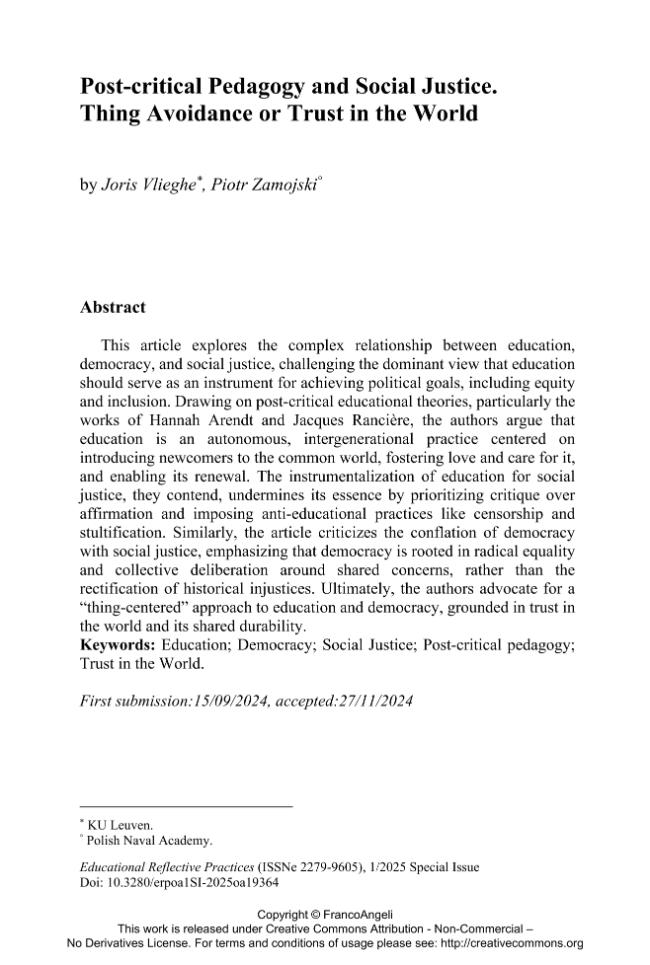
Post-critical Pedagogy and Social Justice : thing Avoidance or Trust in the World
2025 - Franco Angeli
13-28 p.
This article explores the complex relationship between education, democracy, and social justice, challenging the dominant view that education should serve as an instrument for achieving political goals, including equity and inclusion. Drawing on post-critical educational theories, particularly the works of Hannah Arendt and Jacques Rancière, the authors argue that education is an autonomous, intergenerational practice centered on introducing newcomers to the common world, fostering love and care for it, and enabling its renewal. The instrumentalization of education for social justice, they contend, undermines its essence by prioritizing critique over affirmation and imposing anti-educational practices like censorship and stultification. Similarly, the article criticizes the conflation of democracy with social justice, emphasizing that democracy is rooted in radical equality and collective deliberation around shared concerns, rather than the rectification of historical injustices
Ultimately, the authors advocate for a "thing-centered" approach to education and democracy, grounded in trust in the world and its shared durability. [Testo dell'editore]
Forma parte de
Educational reflective practices : 1, 2025 special issue-
Artículos del mismo número (disponibles individualmente)
-
Información
Código DOI: 10.3280/erpoa1SI-2025oa19364
ISSN: 2279-9605
MATERIAS