2025 - Franco Angeli
ID: 6199178
Article PDF (0.08 Mb)
Compatible only with Adobe Acrobat Reader - free software - (find out how to open the files)
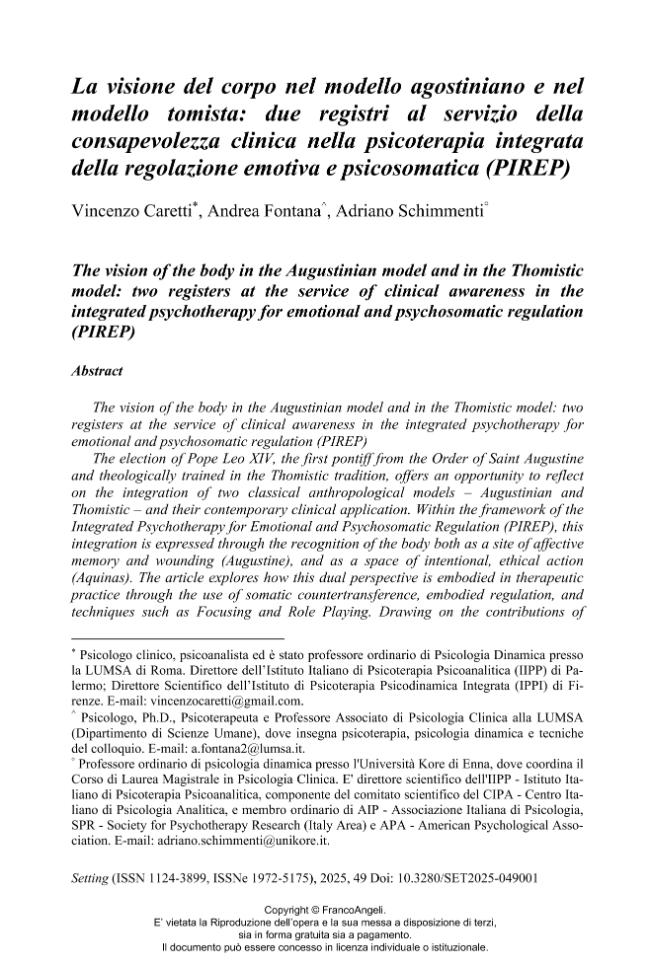
La visione del corpo nel modello agostiniano e nel modello tomista : due registri al servizio della consapevolezza clinica nella psicoterapia integrata della regolazione emotiva e psicosomatica (PIREP)
5-17 p.
L'elezione di Papa Leone XIV, primo pontefice appartenente all'Ordine di Sant'Agostino e teologicamente formato nel solco tomista, offre lo spunto per una riflessione integrativa tra due visioni antropologiche classiche, quella agostiniana e quella tomista, e la loro applicazione clinica contemporanea. All'interno del modello della Psicoterapia Integrata della Regolazione Emotiva e Psicosomatica (PIREP), tale integrazione si declina nella valorizzazione del corpo come luogo della memoria affettiva e della ferita (Agostino), ma anche come sede dell'azione virtuosa e ordinata (Tommaso). L'articolo esplora come questa doppia prospettiva trovi espressione nella pratica terapeutica attraverso il lavoro con il controtransfert somatico, la regolazione incarnata e l'uso di tecniche come il Focusing e il Role Playing. Richiamandosi ai contributi di Schore, Porges, Bromberg e Taylor, il testo propone una visione clinica che unisce interiorità e azione, compassione e discernimento etico, restituendo al corpo un ruolo
centrale nella cura della sofferenza psichica contemporanea. [Testo dell'editore]
The vision of the body in the Augustinian model and in the Thomistic model: two registers at the service of clinical awareness in the integrated psychotherapy for emotional and psychosomatic regulation (PIREP)The election of Pope Leo XIV, the first pontiff from the Order of Saint Augustine and theologically trained in the Thomistic tradition, offers an opportunity to reflect on the integration of two classical anthropological models Augustinian and Thomistic and their contemporary clinical application. Within the framework of the Integrated Psychotherapy for Emotional and Psychosomatic Regulation (PIREP), this integration is expressed through the recognition of the body both as a site of affective memory and wounding (Augustine), and as a space of intentional, ethical action (Aquinas). The article explores how this dual perspective is embodied in therapeutic practice through the use of somatic countertransference, embodied regulation, and techniques such as Focusing and Role Playing. Drawing on the
contributions of Schore, Porges, Bromberg and Taylor, the text proposes a clinical approach that unites interiority and action, compassion and ethical discernment, thus restoring the body to a central role in the healing of contemporary psychic suffering. [Publisher's text]
-
Articles from the same issue (available individually)
-
-
Information
ISSN: 1972-5175
DISCIPLINES
KEYWORDS
- Papa Leone XIV, registro agostiniano, registro tomista, psicoterapia PIREP, controtransfert somatico, cura psicosomatica
- Pope Leo XIV, Augustinian register, Thomistic register, PIREP Psychotherapy, somatic countertransference, psychosomatic care
VAT Excluded
PDF
Article
Article
View the Terms of Use