2025 - Franco Angeli

ID: 6134867
Artikel PDF (0,24 Mb)
Nur mit Adobe Acrobat Reader kompatibel - kostenlose Software - (erfahren Sie, wie Sie die Dokumente öffnen)
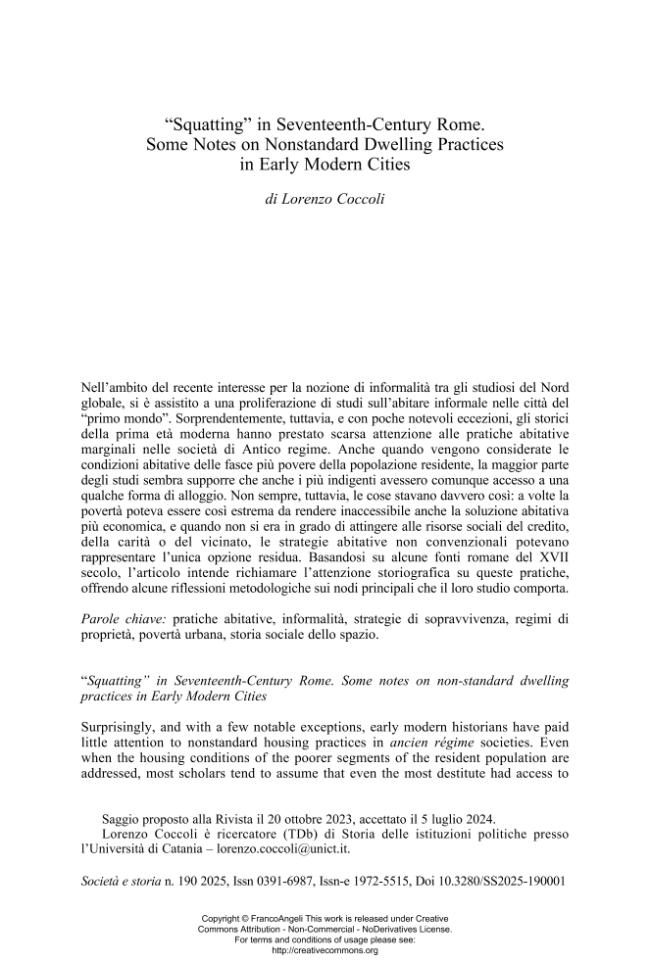
"Squatting" in Seventeenth ÂÂCentury Rome : some Notes on Nonstandard Dwelling Practices in Early Modern Cities
2025 - Franco Angeli
759-785 p.
Nell'ambito del recente interesse per la nozione di informalità tra gli studiosi del Nord globale, si è assistito a una proliferazione di studi sull'abitare informale nelle città del "primo mondo". Sorprendentemente, tuttavia, e con poche notevoli eccezioni, gli storici della prima età moderna hanno prestato scarsa attenzione alle pratiche abitative marginali nelle società di Antico regime. Anche quando vengono considerate le condizioni abitative delle fasce più povere della popolazione residente, la maggior parte degli studi sembra supporre che anche i più indigenti avessero comunque accesso a una qualche forma di alloggio. Non sempre, tuttavia, le cose stavano davvero così: a volte la povertà poteva essere così estrema da rendere inaccessibile anche la soluzione abitativa più economica, e quando non si era in grado di attingere alle risorse sociali del credito, della carità o del vicinato, le strategie abitative non convenzionali potevano rappresentare l'unica opzione residua
Basandosi su alcune fonti romane del XVII secolo, l'articolo intende richiamare l'attenzione storiografica su queste pratiche, offrendo alcune riflessioni metodologiche sui nodi principali che il loro studio comporta. [Testo dell'editore]
Surprisingly, and with a few notable exceptions, early modern historians have paid little attention to nonstandard housing practices in ancien régime societies. Even when the housing conditions of the poorer segments of the resident population are addressed, most scholars tend to assume that even the most destitute had access to some form of lodging, whether through a semiformal arrangement such as subletting or accommodation in a public hospice. This article argues that this was not always the case. In some instances, poverty could be so acute that even the cheapest solutions were out of reach;; and when individuals lacked access to social resources such as credit, charity, or neighbourhood support, nonstandard practices often became the only viable option. Drawing on some seventeenthcentury Roman sources, this article seeks to bring these practices into the field of scholarly inquiry, while offering some methodological reflections on the challenges involved in studying them
[Publisher's text]
Ist Teil von
Società e storia : 190, 4, 2025-
Artikel aus derselben Ausgabe (einzeln erhältlich)
-
-
Informationen
ISSN: 1972-5515
KEYWORDS
- pratiche abitative, informalità, strategie di sopravvivenza, regimi di proprietà, povertà urbana, storia sociale dello spazio
- Dwelling Practices, Informality, Survival Strategies, Property Regimes, Urban Poverty, Social History of Space