2025 - Franco Angeli
ID: 6199220
Artículo PDF (0,68 Mb)
Compatible solo con Adobe Acrobat Reader - software gratuito - (descubra cómo abrir los archivos)
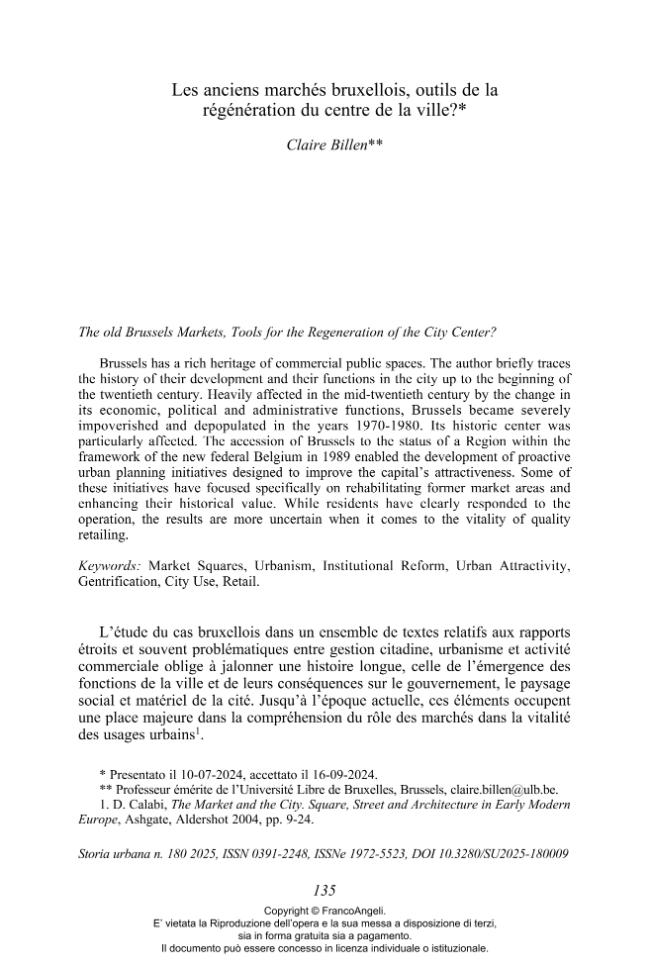
Les anciens marchés bruxellois, outils de la régénération du centre de la ville?
135-150 p.
Brussels has a rich heritage of commercial public spaces. The author briefly traces the history of their development and their functions in the city up to the beginning of the twentieth century. Heavily affected in the mid-twentieth century by the change in its economic, political and administrative functions, Brussels became severely impoverished and depopulated in the years 1970-1980. Its historic center was particularly affected. The accession of Brussels to the status of a Region within the framework of the new federal Belgium in 1989 enabled the development of proactive urban planning initiatives designed to improve the capital's attractiveness. Some of these initiatives have focused specifically on rehabilitating former market areas and enhancing their historical value. While residents have clearly responded to the operation, the results are more uncertain when it comes to the vitality of quality retailing. [Publisher's text]
Forma parte de
Storia urbana : rivista di studi sulle trasformazioni della città e del territorio in età moderna : 180, 1, 2025-
Artículos del mismo número (disponibles individualmente)
-
Información
Código DOI: 10.3280/SU2025-180009
ISSN: 1972-5523
MATERIAS
KEYWORDS
- Piazze del mercato UrbanisticaRiforma istituzionale Attrattività urbana GentrificazioneUso della città Commercio al dettaglio
- Market Squares, Urbanism, Institutional Reform, Urban Attractivity, Gentrification, City Use, Retail
IVA excluido
PDF
Artículo
Artículo
Consulta las condiciones de uso