2025 - Franco Angeli
ID: 6199204
Artículo PDF (0,37 Mb)
Compatible solo con Adobe Acrobat Reader - software gratuito - (descubra cómo abrir los archivos)
Standardizzazione e certificazione della produzione nel comando del lavoro e dei processi lavorativi : il caso dell'agricoltura biologica in Italia
31-58 p.
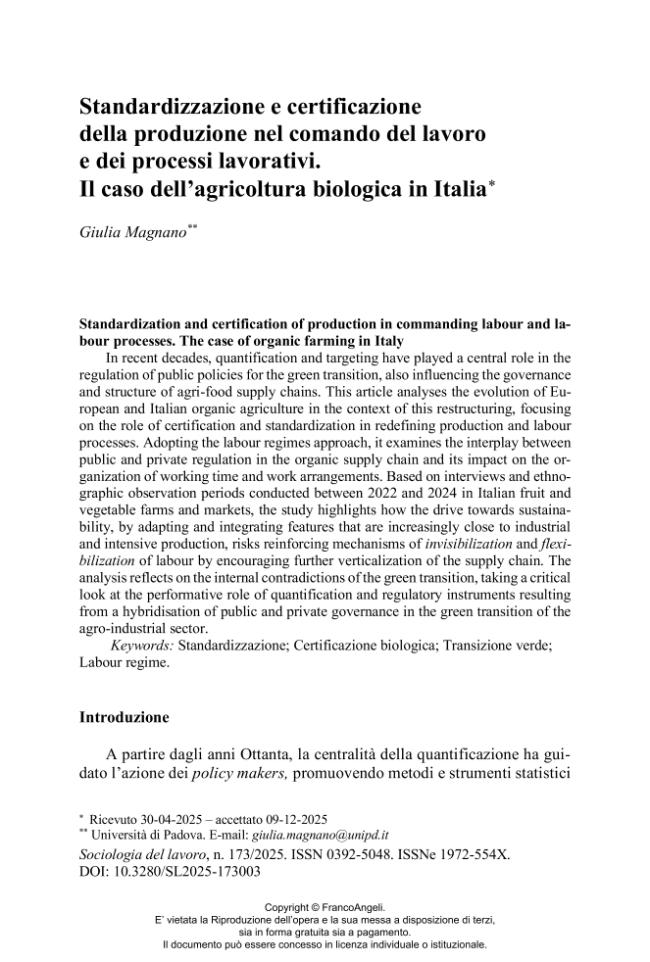
In recent decades, quantification and targeting have played a central role in the regulation of public policies for the green transition, also influencing the governance and structure of agri-food supply chains. This article analyses the evolution of Eu-ropean and Italian organic agriculture in the context of this restructuring, focusing on the role of certification and standardization in redefining production and labour processes. Adopting the labour regimes approach, it examines the interplay between public and private regulation in the organic supply chain and its impact on the or-ganization of working time and work arrangements. Based on interviews and ethno-graphic observation periods conducted between 2022 and 2024 in Italian fruit and vegetable farms and markets, the study highlights how the drive towards sustaina-bility, by adapting and integrating features that are increasingly close to industrial and intensive production, risks reinforcing mechanisms of invisibilization and flexi-bilization of
labour by encouraging further verticalization of the supply chain. The analysis reflects on the internal contradictions of the green transition, taking a critical look at the performative role of quantification and regulatory instruments resulting from a hybridisation of public and private governance in the green transition of the agro-industrial sector. [Publisher's text]
Forma parte de
Sociologia del lavoro : 173, 3, 2025-
Artículos del mismo número (disponibles individualmente)
-
Información
Código DOI: 10.3280/SL2025-173003
ISSN: 1972-554X
MATERIAS
KEYWORDS
- Standardizzazione, Certificazione biologica, Transizione verde, Labour regime
IVA excluido
PDF
Artículo
Artículo
Consulta las condiciones de uso