2025 - Franco Angeli

ID: 6199193
Artículo PDF (0,21 Mb)
Compatible solo con Adobe Acrobat Reader - software gratuito - (descubra cómo abrir los archivos)
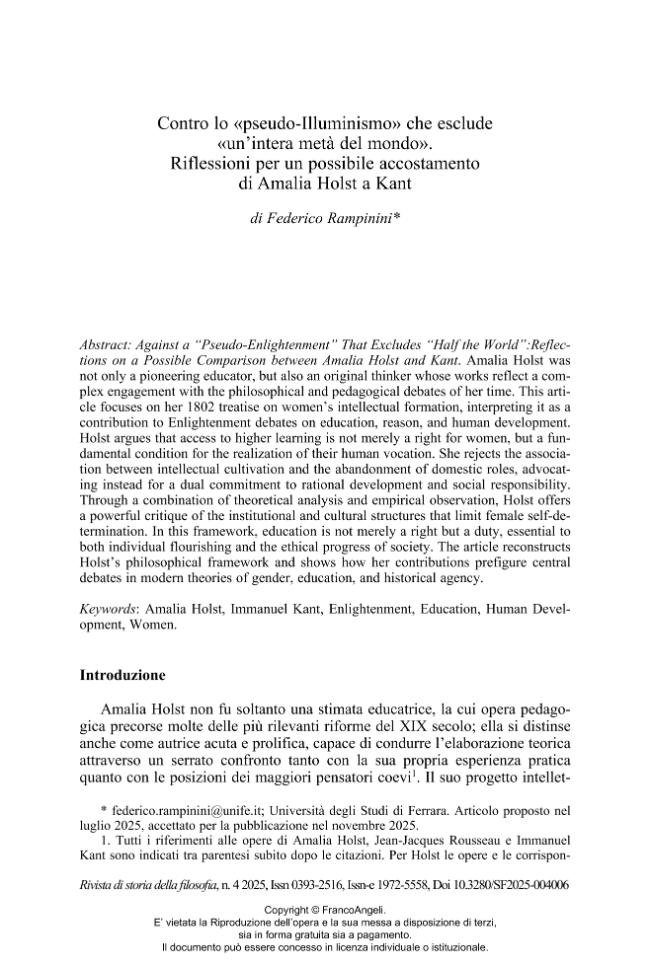
Contro lo "pseudo-Illuminismo" che esclude "un'intera metà del mondo" : riflessioni per un possibile accostamento di Amalia Holst a Kant
619-636 p.
Amalia Holst wasnot only a pioneering educator, but also an original thinker whose works reflect a complex engagement with the philosophical and pedagogical debates of her time. This article focuses on her 1802 treatise on women's intellectual formation, interpreting it as acontribution to Enlightenment debates on education, reason, and human development.Holst argues that access to higher learning is not merely a right for women, but a fundamental condition for the realization of their human vocation. She rejects the association between intellectual cultivation and the abandonment of domestic roles, advocating instead for a dual commitment to rational development and social responsibility.Through a combination of theoretical analysis and empirical observation, Holst offersa powerful critique of the institutional and cultural structures that limit female selfdetermination. In this framework, education is not merely a right but a duty, essential toboth individual flourishing and the ethical progress of society
The article reconstructsHolst's philosophical framework and shows how her contributions prefigure centraldebates in modern theories of gender, education, and historical agency. [Publisher's text]
Forma parte de
Rivista di storia della filosofia : LXXX, 4, 2025-
Artículos del mismo número (disponibles individualmente)
-
Información
Código DOI: 10.3280/SF2025-004006
ISSN: 1972-5558
MATERIAS
KEYWORDS
- Amalia Holst, Immanuel Kant, Enlightenment, Education, Human Devel-ÂÂopment, Women
IVA excluido
PDF
Artículo
Artículo
Consulta las condiciones de uso