
2001 - Brookings Institution Press
ID: 6348600
E-book PDF (15.36 Mb)
Compatible only with Adobe Acrobat Reader - free software - (find out how to open the files)
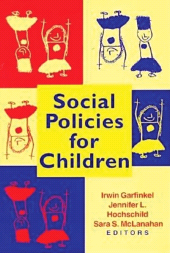
Social Policies for Children
294 p.
Successful social policies for children are critical to Americas future. Yet the status of children in America suggests that the nations policies may not be serving them well. Infant and child mortality rates in the U.S. remain high compared to other western industrialized nations; child poverty rates have worsened in the past decade; poor health care, child abuse, and inadequate schooling and child care persist.This book presents a new set of social policies designed to alleviate these problems and to help satisfy the needs of all children. The policies deal with the seven critical domains affecting children from birth through the passage to adulthood: child care, schooling, transition to work, health care, income security, physical security, and child abuse.While nearly everyone agrees that children are in trouble, there is considerable debate over what kind of trouble they are in, why this is so, and whether government can or should more actively seek to solve these problems. Americans are evenly divided
on the question of whether childrens problems are more economic or moral in origin. The seven proposals in this volume both reflect and cut across ideological disagreements. Some call for more government, others call for less, and all call for different government methods for achieving socially agreed upon goals.Recommendations include: replacing major welfare programs and tax subsidies with a set of universal policies, including national health insurance, child support assurance, and universal child care; offering publicly funded vouchers to allow poor children in inner-city neighborhoods to choose their own schools; using both private and governmental resources to get tough on crime through more stringent criminal justice policies and dramatic social measures; and expanding apprenticeship programs for non-college bound youths.In addition to the editors, the contributors are Barbara R. Bergmann and Robert I. Lerman, American University; Douglas J. Besharov, American Enterprise Institute; John J. DiIulio,
Jr., Princeton University; Julia Graham Lear, George Washington University; and Diane Ravitch, New York University. [Publisher's text]
568346 characters.
-
Information
ISBN: 9780815747369
DISCIPLINES
VAT Excluded
PDF
E-book
E-book
View the Terms of Use