2025 - Leo S. Olschki
ID: 6202560
Article PDF (0.58 Mb)
Compatible only with Adobe Acrobat Reader - free software - (find out how to open the files)
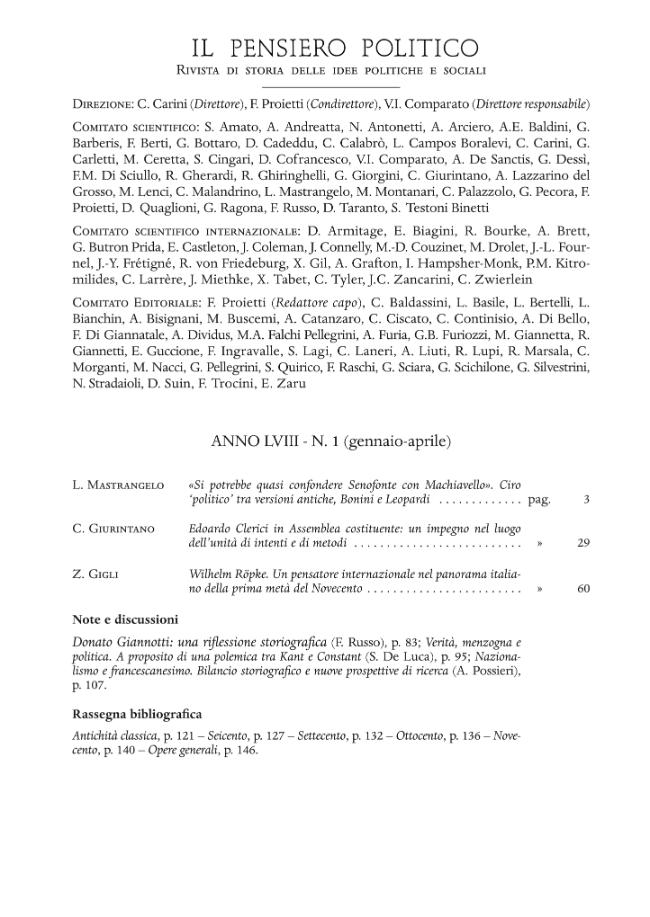
Wilhelm Röpke : un pensatore internazionale nel panorama italiano della prima metà del Novecento
P. 60-82
Wilhelm Röpke, a key figure of ordoliberalism, enjoyed a multifaceted reception in mid-20th-century Italy, where his ideas significantly shaped postwar liberal discourse. While internationally known for his criticism of both unregulated capitalism and collectivism, in Italy Röpke became a crucial point of reference for intellectuals seeking a ‘third way' between extremes. His influence was particularly visible among Italian liberals such as Luigi Einaudi, who admired Röpke's advocacy for market economies grounded in ethical and social principles. Einaudi not only promoted Röpke's work but echoed his emphasis on ‘conformist interventionism' and the necessity of moral foundations for economic systems. Philosopher Carlo Antoni also engaged deeply with Röpke's ideas, aligning them with Crocean liberalism to balance individual freedom with social cohesion. Röpke's critique of rationalism and mass society resonated with Antoni's own rejection of deterministic ideologies.
Beyond these affinities, Röpke's work sparked polarized reactions across Italy's intellectual spectrum. Marxist historian Delio Cantimori dismissed his vision as utopian and reactionary, while Guido Calogero misread Röpke through a liberal-socialist lens. Communist leader Palmiro Togliatti rejected him outright, viewing his ‘third way' as a thinly veiled justification for bourgeois restoration. Röpke's participation in Italian public debate, through journals like «Il Mondo», «La Tribuna», and «Risorgimento Liberale», underlines his impact not only as a theorist but as a contributor to the redefinition of post-fascist liberalism. His reception in Italy reveals both the plasticity of his thought and the broader tensions within Italian liberalism as it sought to reconcile ethical tradition with economic modernization. [Publisher's text].
83345 characters
-
Articles from the same issue (available individually)
-
Information
DOI: 10.82026/12315
ISSN: 2035-7958
DISCIPLINES
VAT Excluded
PDF
Article
Article
View the Terms of Use