2025 - Franco Angeli
ID: 6134722
Article PDF (1.01 Mb)
Compatible only with Adobe Acrobat Reader - free software - (find out how to open the files)
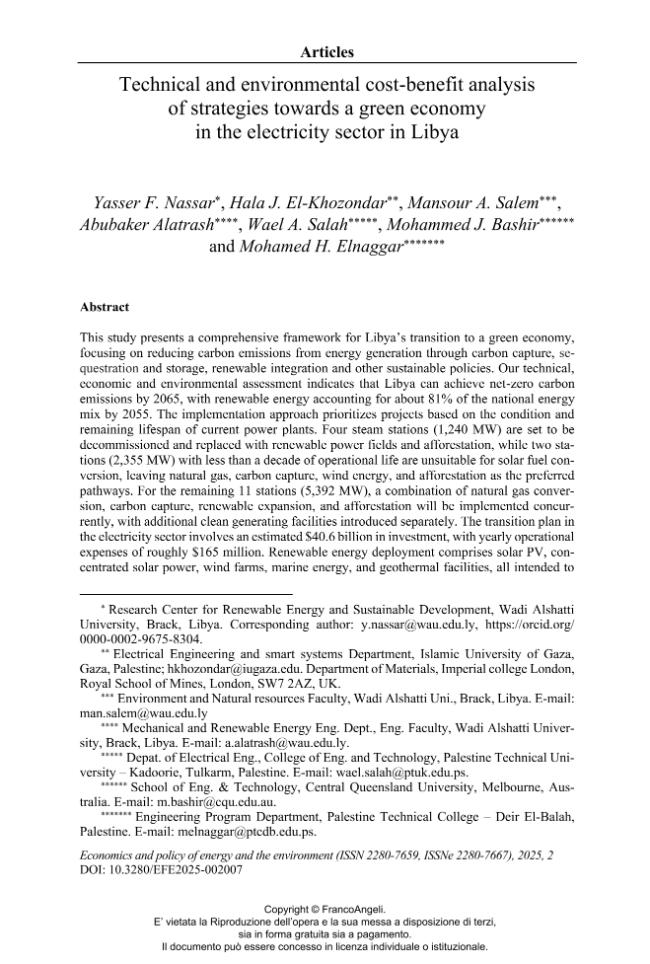
Technical and environmental cost benefit analysis of strategies towards a green economy in the electricity sector in Libya
133-167 p.
This study presents a comprehensive framework for Libya's transition to a green economy, focusing on reducing carbon emissions from energy generation through carbon capture, sequestration and storage, renewable integration and other sustainable policies. Our technical, economic and environmental assessment indicates that Libya can achieve netzero carbon emissions by 2065, with renewable energy accounting for about 81% of the national energy mix by 2055. The implementation approach prioritizes projects based on the condition and remaining lifespan of current power plants. Four steam stations (1,240 MW) are set to be decommissioned and replaced with renewable power fields and afforestation, while two stations (2,355 MW) with less than a decade of operational life are unsuitable for solar fuel conversion, leaving natural gas, carbon capture, wind energy, and afforestation as the preferred pathways. For the remaining 11 stations (5,392 MW), a combination of natural gas conversion, carbon
capture, renewable expansion, and afforestation will be implemented concurrently, with additional clean generating facilities introduced separately. The transition plan in the electricity sector involves an estimated {dollar}40.6 billion in investment, with yearly operational expenses of roughly {dollar}165 million. Renewable energy deployment comprises solar PV, concentrated solar power, wind farms, marine energy, and geothermal facilities, all intended to replace old units and meet future demand. Pilot projects like the Brack hybrid renewable station demonstrate that complete energy coverage may be achieved while lowering dependency on fossil fuels and COâ emissions. Furthermore, largescale afforestation initiatives will help to reduce carbon emissions and ensure further environmental benefits, with return on investment through the sale of CO2 credits commencing within the first few years. Collectively, these policies provide a realistic route for Libya to develop a sustainable, diverse, and
lowcarbon power industry. [Publisher's text]
-
Articles from the same issue (available individually)
-
Information
ISSN: 2280-7667
DISCIPLINES
KEYWORDS
- Green economy, energy industry, alternative and environmentally friendly energies, negative carbon emission systems, netzero carbon
VAT Excluded
PDF
Article
Article
View the Terms of Use