
2015 - John Wiley et Sons Ltd.
ID: 6275994
eBook PDF (9,1 Mb)
Nur mit Adobe Acrobat Reader kompatibel - kostenlose Software - (erfahren Sie, wie Sie die Dokumente öffnen)
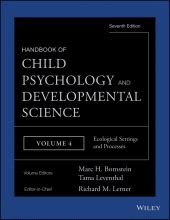
Handbook of Child Psychology and Developmental Science, Ecological Settings and Processes
944 p.
volume emphasizes that the child's environment is complex, multi-dimensional, and structurally organized into interlinked contexts; children actively contribute to their development; the child and the environment are inextricably linked, and contributions of both child and environment are essential to explain or understand development. Understand the role of parents, other family members, peers, and other adults (teachers, coaches, mentors) in a child's development Discover the key neighborhood/community and institutional settings of human development Examine the role of activities, work, and media in child and adolescent development Learn about the role of medicine, law, government, war and disaster, culture, and history in contributing to the processes of human development The scholarship within this volume and, as well, across the four volumes of this edition, illustrate that developmental science is in the midst of a very exciting period. There is a paradigm shift that involves increasingly greater
understanding of how to describe, explain, and optimize the course of human life for diverse individuals living within diverse contexts. This Handbook is the definitive reference for educators, policy-makers, researchers, students, and practitioners in human development, psychology, sociology, anthropology, and neuroscience. [Publisher's Text]
100000 characters.
-
Informationen
ISBN: 9781118953914
THEMENBEREICHE
MwSt ausgenomen
PDF
eBook
eBook
Erlaubte Funktionen anzeigen