
2026 - USiena Press
ID: 6259030
eBook PDF (6,77 Mb)
Nur mit Adobe Acrobat Reader kompatibel - kostenlose Software - (erfahren Sie, wie Sie die Dokumente öffnen)
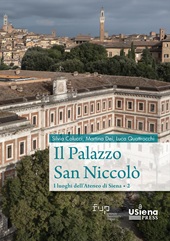
Il Palazzo San Niccolò : i luoghi dell'Ateneo di Siena : 2
2026 - USiena Press
118 p. : col. ill.
Includes bibliographical references and index
Adiacente alle mura urbane di Siena a ovest di Porta Romana, il Palazzo San Niccolò sorge in un'area dalle secolari e complesse vicende edilizie che iniziano nel 1346, quando papa Clemente VI approvò la fondazione del convento di San Niccolò. Perduto l'archivio in un incendio nel 1560, le trasformazioni del convento sono ricostruibili tramite visite pastorali, resoconti di spese e rare immagini. Soppresso in età napoleonica, il monastero fu trasformato nel 1818 in ospedale e quindi in manicomio, oggetto di continui ampliamenti fino alla demolizione dell'antico complesso. Dal 1866 Francesco Azzurri progettò un moderno impianto a padiglioni completato nel 1890, di cui Palazzo San Niccolò costituisce l'edificio centrale. Chiuso definitamente il manicomio nel 1999, l'area è attualmente campus universitario, frutto del progetto di riconversione di Enzo Zacchiroli. Il volume, sulla base di documentazione inedita, ricostruisce l'intera storia edilizia del sito [Testo dell'editore].
Close to the city walls of Siena, west of Porta Romana, Palazzo San Niccolò stands in an area with centuries of complex building history dating back to 1346, when Pope Clement VI approved the foundation of the convent of San Niccolò. Although the archives were lost in a fire in 1560, the transformations of the convent can be reconstructed through pastoral visits, expense reports and rare images. Suppressed during the Napoleonic era, the monastery was converted into a hospital in 1818 and then into a mental asylum, undergoing continuous expansion until the demolition of the ancient complex. In 1866, Francesco Azzurri designed a modern pavilion complex, completed in 1890, with Palazzo San Niccolò as its central building. The mental hospital closed permanently in 1999, and the area is now a university campus, the result of a conversion project by Enzo Zacchiroli. Based on unpublished documentation, this volume reconstructs the entire building history of the site [Publisher's text].
Collected essays
238251 characters
-
Informationen
PDF
eB
eBook
eBook
Erlaubte Funktionen anzeigen