2025 - Leo S. Olschki
ID: 6202557
Artikel PDF (0,59 Mb)
Nur mit Adobe Acrobat Reader kompatibel - kostenlose Software - (erfahren Sie, wie Sie die Dokumente öffnen)
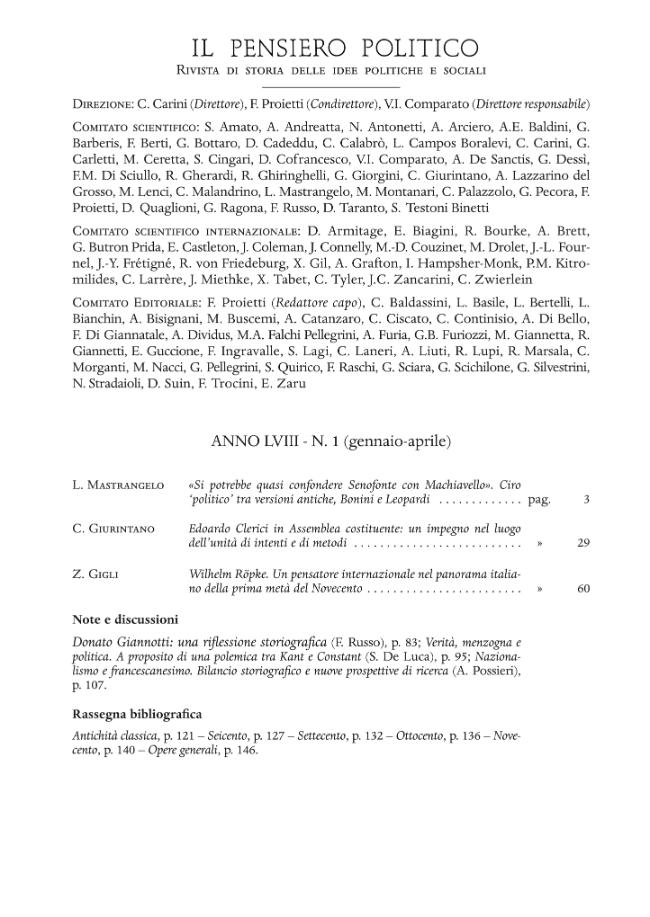
"Si potrebbe quasi confondere Senofonte con Machiavello" : Ciro "politico" tra versioni antiche, Bonini e Leopardi
P. 3-28
Leopardi was right to doubt the veracity of the deeds narrated in Xenophon's Cyropaedia, a work that Cicero had already criticized. Both Cicero and Leopardi correctly identified its true nature: as the title itself suggests, the Cyropaedia is a pedagogical work, intended to propose a theoretical model through a character rather than to function as a historical account in the strict sense. The historiographical debate concerning the historical truth of Cyrus's adventures as narrated in the Cyropaedia has been long and complex, since the various legends and versions of both public and private episodes are often contradictory. From the perspective of the history of political thought, however, this cannot be the primary object of analysis. What matters instead is Xenophon's text itself, which aims to convey specific precepts for rulers, regardless of how events may actually have unfolded.
This approach may be methodologically unsatisfactory from the philologist's perspective, but it is understandable in a work conceived as a manual of conduct for a ruler. This aspect is evident when Xenophon's pages are reread as a kind of treatise on the history of political thought, offering a specific imperial interpretation of a classical narrative form, namely that of the specula principis. The story of Cyrus, both real and fictional, was frequently retold in the literature and drama of the seventeenth and early eighteenth centuries. An interesting interpretation, set in the particular context of the seventeenth-century debate on Machiavellianism, is that proposed by Filippo Maria Bonini, an abbot born in Chiavari in 1612 [Publisher's text].
90317 characters
Ist Teil von
Pensiero politico : rivista di storia delle idee politiche e sociali : LVIII, n. 1, 2025-
Artikel aus derselben Ausgabe (einzeln erhältlich)
-
-
Informationen
DOI: 10.82026/12313
ISSN: 2035-7958
THEMENBEREICHE
MwSt ausgenomen
PDF
Artikel
Artikel
Erlaubte Funktionen anzeigen