2026 - Franco Angeli
ID: 6199151
Artikel PDF (0,35 Mb)
Nur mit Adobe Acrobat Reader kompatibel - kostenlose Software - (erfahren Sie, wie Sie die Dokumente öffnen)
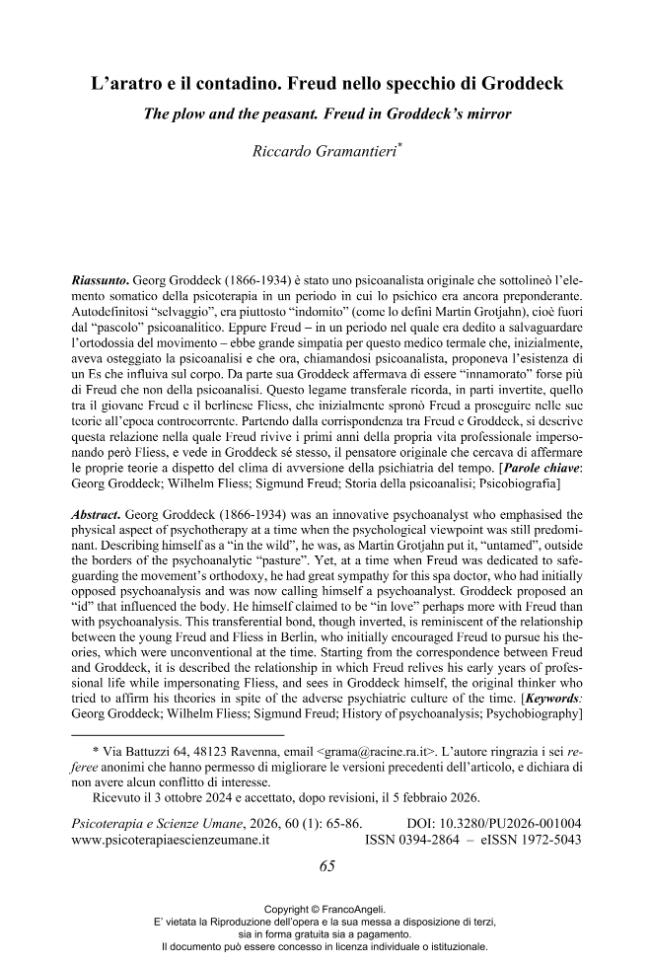
L'aratro e il contadino : Freud nello specchio di Groddeck
65-86 p.
Georg Groddeck (1866-1934) è stato uno psicoanalista originale che sottolineò l'elemento somatico della psicoterapia in un periodo in cui lo psichico era ancora preponderante. Autodefinitosi "selvaggio", era piuttosto "indomito" (come lo definì Martin Grotjahn), cioè fuori dal "pascolo" psicoanalitico. Eppure Freud - in un periodo nel quale era dedito a salvaguardare l'ortodossia del movimento - ebbe grande simpatia per questo medico termale che, inizialmente, aveva osteggiato la psicoanalisi e che ora, chiamandosi psicoanalista, proponeva l'esistenza di un Es che influiva sul corpo. Da parte sua Groddeck affermava di essere "innamorato" forse più di Freud che non della psicoanalisi. Questo legame transferale ricorda, in parti invertite, quello tra il giovane Freud e il berlinese Fliess, che inizialmente spronò Freud a proseguire nelle sue teorie all'epoca controcorrente. Partendo dalla corrispondenza tra Freud e Groddeck, si descrive questa relazione nella quale Freud rivive i primi anni della propria vita
professionale impersonando però Fliess, e vede in Groddeck sé stesso, il pensatore originale che cercava di affermare le proprie teorie a dispetto del clima di avversione della psichiatria del tempo. [Testo dell'editore]
Georg Groddeck (1866-1934) was an innovative psychoanalyst who emphasised the physical aspect of psychotherapy at a time when the psychological viewpoint was still predominant. Describing himself as a "in the wild", he was, as Martin Grotjahn put it, "untamed", outside the borders of the psychoanalytic "pasture". Yet, at a time when Freud was dedicated to safeguarding the movement's orthodoxy, he had great sympathy for this spa doctor, who had initially opposed psychoanalysis and was now calling himself a psychoanalyst. Groddeck proposed an "id" that influenced the body. He himself claimed to be "in love" perhaps more with Freud than with psychoanalysis. This transferential bond, though inverted, is reminiscent of the relationship between the young Freud and Fliess in Berlin, who initially encouraged Freud to pursue his theories, which were unconventional at the time. Starting from the correspondence between Freud and Groddeck, it is described the relationship in which Freud relives his early years of
professional life while impersonating Fliess, and sees in Groddeck himself, the original thinker who tried to affirm his theories in spite of the adverse psychiatric culture of the time. [Publisher's text]
Ist Teil von
Psicoterapia e scienze umane : LX, 1, 2026-
Artikel aus derselben Ausgabe (einzeln erhältlich)
-
Informationen
ISSN: 1972-5043
THEMENBEREICHE
KEYWORDS
- Georg Groddeck, Wilhelm Fliess, Sigmund Freud, Storia della psicoanalisi, Psicobiografia
- Georg Groddeck, Wilhelm Fliess, Sigmund Freud, History of psychoanalysis, Psychobiography
MwSt ausgenomen
PDF
Artikel
Artikel
Erlaubte Funktionen anzeigen